Full article
Money rarely moves in a straight line between people. In our everyday lives, it moves through friendships, families, workplaces and communities, creating a web of small financial obligations that we often don't think of as a financial system at all.
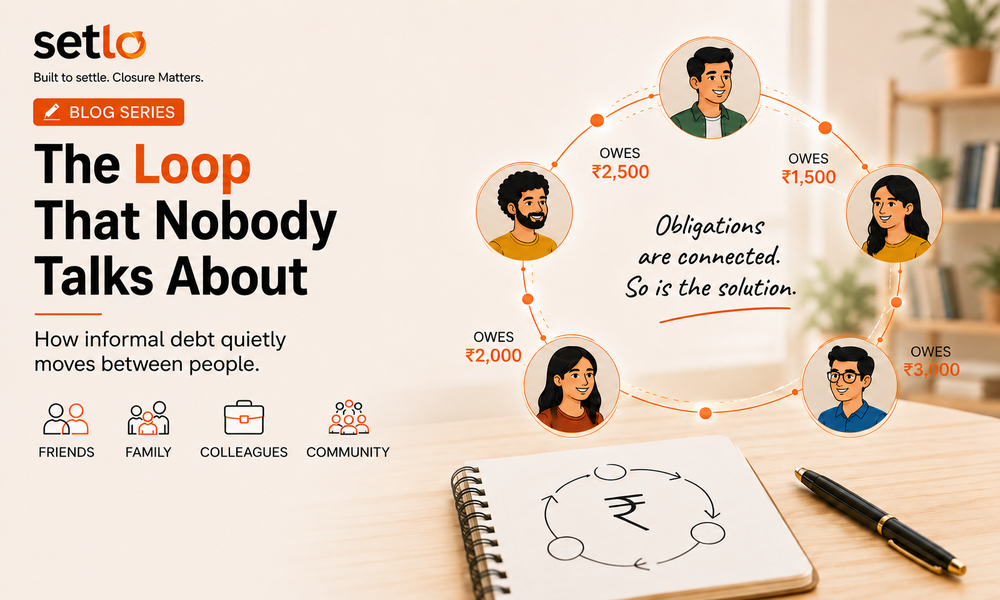
A friend lends ₹2,000 to another friend. That friend owes ₹1,500 to someone else. A family member has borrowed ₹3,000 from a colleague, while another person has an obligation towards the first friend. None of these transactions may seem significant on their own. Yet together, they can create something much more interesting—a network of financial relationships where one person's payable can be connected to another person's receivable.
This is the reality of informal finance. It happens every day, often without contracts, collateral, interest or formal repayment schedules. Someone pays for dinner and says, "You can give it to me later." A friend helps during an emergency. A colleague covers an expense. A family member provides temporary financial support. The intention is usually simple: help someone today and settle the obligation later.
But "later" can sometimes become much later.
Life gets busy. People forget. Conversations get postponed. New obligations are created before old ones are settled. Over time, what began as a simple financial exchange can become a collection of open balances spread across different people.
The interesting part is that these obligations don't always exist independently.
One person owes another. That person owes someone else. The third person may owe someone who, in turn, owes the first person. When these obligations connect back to one another, they can form a financial loop.
The difficulty is that we naturally look at money from an individual perspective. We ask, "Who owes me?" or "Whom do I owe?" We rarely have a complete view of how those obligations connect across a group of people. As a result, we see individual balances but not the larger network behind them.
This is where the idea of a financial loop becomes important.
A connected set of obligations can sometimes create a path towards closure without every person having to settle every individual transaction separately. Instead of looking at each debt as an isolated problem, we can look at the network and understand how the obligations are connected.
That is the thinking behind Setlo.
Setlo is not about encouraging people to borrow more. It is about bringing visibility to the informal financial obligations that already exist and helping people find a structured path towards closure. When the relationships between obligations become visible, what appears to be several unrelated debts can sometimes reveal a connected loop.
And that changes the way we think about settlement.
An open obligation is one thing.
An open loop is something else entirely.
Because sometimes, the first step towards settling what we owe isn't finding more money.
It is simply finding the loop.
Setlo — Built to settle. Closure Matters.